






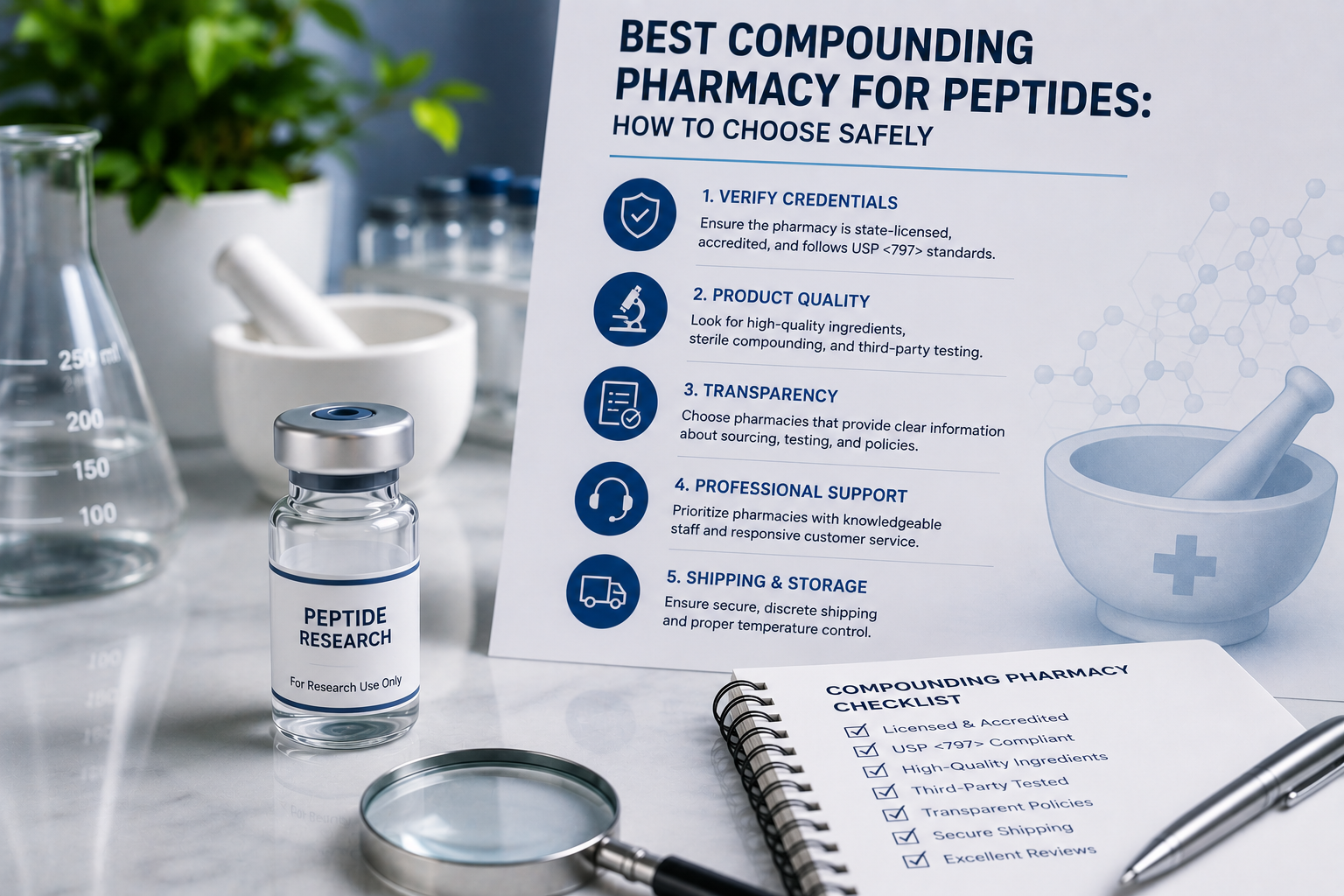

Every compounding pharmacy that touches peptides claims to be licensed, sterile, and trustworthy. Very few make it easy to verify any of that, and the ones that make verification easy tend to be the ones worth using in the first place.
The best compounding pharmacy for peptides isn’t the cheapest, the fastest to ship, or the one with the most polished marketing. It’s the one that can prove its licensing, explain whether it operates as a 503A pharmacy or a 503B outsourcing facility, document sterile practices, and hand over batch-specific quality certificates without hesitation.
None of this ranks or names specific pharmacies, and none of it is medical advice or a substitute for a licensed provider’s prescribing decision. It’s a framework for verifying licensing, sterility, and documentation before price or convenience ever enter the conversation.
What Makes the Best Compounding Pharmacy for Peptides?
A strong peptide compounding pharmacy has verifiable credentials, a clear prescription process, a transparent pharmacy category, documented sterile practices for injectable preparations, quality certificates, appropriate storage and shipping practices, realistic claims, and a pharmacist who’s genuinely reachable when questions come up. The best peptide pharmacy for any given patient is simply the one that can prove all of this on request, not the one that advertises loudest.
Why “Best” Should Not Mean Cheapest
A low price can reflect weak documentation, unclear sourcing, thin support, or inadequate quality controls just as easily as it can reflect genuine efficiency. A higher price doesn’t automatically prove quality either. Safety and verification come first; price comparison is a later step, not the first filter.
Why “Best” Should Not Mean Easiest to Order From
A pharmacy that ships prescription peptides with little to no provider involvement is a red flag, not a convenience feature. Some friction in the process is appropriate when medical products, sterile preparations, and patient safety are involved. A licensed compounding pharmacy has a clear prescription and verification process, not a checkout page that skips straight to payment.
503A vs 503B: What Type of Compounding Pharmacy Are You Evaluating?
A 503A compounding pharmacy and a 503B outsourcing facility are genuinely different categories, and knowing which one you’re dealing with changes how it should be verified.
503A vs 503B for Peptide Compounding
| Category | 503A Compounding Pharmacy | 503B Outsourcing Facility |
| Primary model | Traditional patient-specific compounding | Larger-scale outsourcing facility model |
| Prescription relationship | Generally compounds for individually identified patients | May compound for healthcare facilities under 503B conditions |
| Oversight | State boards plus applicable FDA authority | FDA registration and additional federal requirements |
| Sterile production | Must follow applicable sterile compounding standards when preparing sterile products | Must meet more manufacturing-like requirements, including CGMP expectations |
| Verification step | Check state pharmacy license and pharmacy board records | Check FDA registered outsourcing facility list |
| Patient relevance | Often used for individualized prescriptions | Often used by hospitals, clinics, or healthcare facilities |
| Key caveat | Licensed does not automatically mean every peptide can be compounded | FDA registration does not mean FDA approval of each compounded product |
Why 503A and 503B Status Matters
Knowing which category applies changes what oversight body is relevant and how the pharmacy should be verified in practice. Neither category replaces product-specific quality review, and neither one means a compounded peptide carries FDA approval.
Why FDA Registration Is Not FDA Approval
A facility registered with FDA as a 503B outsourcing facility hasn’t had every compounded peptide it prepares individually approved by FDA. Registration confirms a facility category; it says nothing about whether a specific preparation was reviewed for safety or effectiveness.
Certified Peptide Solutions’ terms and conditions page outlines the kind of clear regulatory positioning worth expecting from any pharmacy or supplier operating in this space.
Are Compounded Peptides FDA-Approved?
No. FDA explains that compounded drugs are not FDA-approved, meaning the agency doesn’t review each compounded preparation for safety, effectiveness, or quality before it reaches a patient the way it reviews approved drugs. Compounded peptides can still serve genuine patient-specific needs, but that comes with a corresponding need for careful oversight, documentation, and quality controls that an approved drug’s manufacturing process already builds in.
FDA-Approved Drug vs Compounded Peptide vs Research-Use Peptide
| Category | What It Means | Why It Matters |
| FDA-approved drug | Reviewed by FDA for specific indications, labeling, safety, effectiveness, and quality | Comes with approved prescribing information and manufacturing standards |
| Compounded peptide | Prepared by a pharmacy under applicable compounding rules | Not FDA-approved; quality depends on pharmacy practices and compliance |
| 503B compounded preparation | Prepared by an FDA-registered outsourcing facility under 503B conditions | Still not automatically FDA-approved |
| Research-use peptide | Sold for laboratory research only | Not intended for patient use or clinical treatment |
| Gray-market peptide | Unclear source or regulatory status | Higher risk of mislabeling, contamination, and unsupported claims |
Why This Distinction Matters for Patient Safety
Approved-drug standards and compounded-drug standards aren’t identical, and treating them as interchangeable is where most confusion about compounded peptides starts. Research-use materials shouldn’t be used as patient medications under any circumstances, and safety or effectiveness claims need real evidence behind them, not pharmacy marketing copy.
Key Factors in Selecting a Peptide Compounding Pharmacy
Peptide Compounding Pharmacy Selection Checklist
| Factor | What to Look For | Red Flag |
| Pharmacy license | Active license in relevant state or jurisdiction | No license number or unverifiable license |
| Pharmacy type | Clear 503A or 503B status where applicable | Vague “FDA registered” claims |
| Prescription process | Requires appropriate provider prescription | Direct sale without medical oversight |
| Pharmacist access | Can speak with a pharmacist or qualified representative | Sales-only support |
| Sterile practices | Explains sterile compounding process where applicable | No sterile-practice information for injectable products |
| Quality documentation | Batch-specific COA or quality certificate where appropriate | Generic or missing documentation |
| Identity testing | Confirms compound identity where applicable | Purity claim without identity support |
| Purity testing | HPLC or comparable method where relevant | “99% pure” with no method |
| Sterility testing | Relevant for injectable preparations | Purity used as a substitute for sterility |
| Endotoxin controls | Relevant for injectable products | No discussion of endotoxin risk |
| Storage and shipping | Temperature controls and handling instructions | No storage/shipping clarity |
| Adverse-event process | Explains what to do if problems occur | No safety follow-up |
| Claim discipline | Avoids exaggerated outcomes | “Guaranteed results” or miracle claims |
| Regulatory clarity | Explains compounded vs approved vs research-use | Blurs categories |
Questions to Ask a Pharmacy Before Ordering Peptides
A peptide prescription pharmacy should require appropriate prescription and provider involvement rather than operating like a direct-to-consumer research vendor. The questions below cover the areas that matter most.
Licensing and Status Questions
- Are you licensed in my state or jurisdiction?
- What is your license number?
- Are you a 503A pharmacy, 503B outsourcing facility, or another pharmacy model?
- If 503B, are you listed on FDA’s registered outsourcing facility list?
- If 503A, can I verify your license through the state board of pharmacy?
- Do you ship to my state legally?
Prescription and Provider Questions
- Do you require a valid prescription?
- Who must write the prescription?
- Do you work directly with licensed physicians or clinics?
- How do you verify prescriber credentials?
- Can the pharmacist answer questions about the preparation?
- What patient counseling or safety information is provided?
Quality and Testing Questions
- Is the peptide compounded as a sterile preparation?
- Is the preparation intended for injection, topical use, or another route?
- Is there a batch-specific COA?
- Does the COA include identity testing?
- Does the COA include purity testing?
- Is sterility testing performed where relevant?
- Is endotoxin testing available where relevant?
- What is the beyond-use date?
- How is storage handled?
- How is shipping temperature controlled?
Safety and Adverse Event Questions
- What should patients do if they experience a reaction?
- How are quality complaints handled?
- How are adverse events documented?
- What happens if a product is recalled?
- Who should be contacted after hours?
How to Verify Peptide Quality Certificates From Pharmacies
Peptide quality certificates can be genuinely useful, but only when they’re specific, traceable, and relevant to the exact preparation in question. A certificate that doesn’t identify the compound, lot, method, date, or lab is weak regardless of how official it looks. Peptide pharmacy quality overall should be judged the same way: documentation, sterility controls, identity testing, lot traceability, and transparent sourcing, not a single high-purity peptides claim printed on a page.
Peptide COA Verification Checklist
| COA Field | What It Should Show | Why It Matters |
| Compound name | Exact peptide or preparation name | Confirms document matches product |
| Lot or batch number | Specific batch identifier | Supports traceability |
| Test date | When analysis was performed | Shows relevance |
| Testing method | HPLC, LC-MS, sterility, endotoxin, etc. | Shows what was genuinely tested |
| Purity result | Analytical purity percentage where relevant | Helps evaluate impurities |
| Identity confirmation | Molecular mass or identity support where available | Helps confirm compound identity |
| Sterility result | Relevant for sterile preparations | Chemical purity does not prove microbial safety |
| Endotoxin result | Relevant for injectable products | Supports injectable safety evaluation |
| Lab or reviewer | Named lab, pharmacist, or controlled document | Supports accountability |
| Storage conditions | Recommended handling | Helps preserve product integrity |
| Beyond-use date | Time limit for use under stated conditions | Important for compounded preparations |
Why COA Does Not Equal Safety
A COA is a documentation tool, not a safety guarantee. It doesn’t prove the product is FDA-approved, doesn’t prove clinical effectiveness, and doesn’t replace medical supervision. Unless sterility and endotoxin testing are specifically included, a COA may say nothing about either one.
Why Batch-Specific Documentation Matters
Generic COAs, outdated reports, or screenshots detached from any specific batch carry far less weight than a document tied to the exact lot in question.
Certified Peptide Solutions’ COA library shows what batch-specific documentation looks like in practice, a useful comparison point for evaluating any pharmacy’s own quality certificates.
Checklist for Evaluating Sterile Practices in Peptide Pharmacies
Sterile Practice Questions
| Sterile Practice Area | What to Ask | Why It Matters |
| USP <797> practices | How does the pharmacy follow sterile compounding standards? | Shows awareness of sterile preparation requirements |
| Personnel training | How are compounding staff trained and qualified? | Human technique affects contamination risk |
| Cleanroom controls | What cleanroom or sterile environment is used? | Environment affects microbial risk |
| Environmental monitoring | Is air and surface monitoring performed? | Helps detect contamination risk |
| Sterility testing | Are sterile preparations tested where required or appropriate? | Supports microbial safety evaluation |
| Endotoxin testing | Is endotoxin testing performed for injectable preparations? | Endotoxin contamination can be serious |
| Beyond-use dating | How is BUD assigned? | Affects product storage and usability |
| Storage conditions | What temperature and handling are required? | Peptides may degrade if mishandled |
| Shipping controls | Is cold-chain or temperature control used where needed? | Preserves product integrity |
| Complaint handling | How are quality concerns investigated? | Shows safety accountability |
USP General Chapter <797> describes the requirements behind these questions in detail, covering compounding personnel responsibilities, training, facilities, environmental monitoring, and storage and testing of finished preparations. USP 797 sterile compounding standards are the reference point most of this checklist is built around.
Purity vs Sterility
A peptide can test high for purity and still be unsuitable for injection if sterility and endotoxin safety were never separately established. Sterile compounded peptides require more scrutiny than nonsterile preparations for exactly this reason. Peptide purity testing and peptide sterility testing answer genuinely different questions, and a strong result on one says nothing about the other. A sterile compounding pharmacy should be able to walk through all of this without hesitation.
Why Injectable Peptides Need Higher Scrutiny
An injectable peptide pharmacy bypasses normal external barriers by design, which means contamination, endotoxin exposure, incorrect identity, poor storage, or improper compounding all carry higher stakes than they would for a topical product. Endotoxin testing peptides specifically matters here, since endotoxin contamination can trigger serious inflammatory reactions that a purity test alone would never catch.
Regulatory Considerations When Choosing a Peptide Pharmacy Provider
Peptide compounding regulations cover state pharmacy licensing, prescriber requirements, 503A vs 503B status, FDA’s outsourcing facility list, the fact that compounded drugs aren’t FDA-approved, sterile compounding requirements, the research-use vs patient-use distinction, interstate shipping rules, state board oversight, and how misleading “FDA registered” language gets used in marketing.
State Board Verification
Pharmacy license verification generally starts with state boards of pharmacy, which provide license lookup tools. Readers should verify the pharmacy name, license status, location, disciplinary history where available, and whether the pharmacy is authorized to operate in their state specifically.
FDA Outsourcing Facility Verification
If a pharmacy claims 503B status, its name should appear on FDA’s registered outsourcing facility list. Registration confirms facility category; it doesn’t mean FDA approved the specific peptide being compounded there.
Prescription and Jurisdiction Questions
A pharmacy may not be legally permitted to ship every compounded product into every state. Patients should ask directly whether the pharmacy can dispense into their specific jurisdiction rather than assuming a national-looking website means nationwide legal reach.
How to Find Physician-Partnered Peptide Compounding Pharmacies
A physician-partnered peptide pharmacy shouldn’t be assumed safe just because it’s associated with a clinic or physician network. The partnership can help with prescription oversight, but the pharmacy itself still needs independent verification on its own terms.
What Physician Partnership Should Mean
A genuine partnership includes a valid prescription pathway, real prescriber-pharmacist communication, patient-specific review, counseling or safety information, follow-up for adverse events, and clear documentation of intended use.
What Physician Partnership Should Not Mean
It shouldn’t mean automatic approval, a sales funnel dressed up as a medical evaluation, or a reason to skip verifying the pharmacy’s license, product documentation, sterile practices, or informed consent process.
Questions to Ask About Physician Partnerships
- Who is the prescriber?
- Are they licensed in the patient’s state?
- Does the prescriber evaluate medical history?
- Does the pharmacy verify prescription validity?
- Can the patient speak with a pharmacist?
- Are risks, alternatives, and evidence limits discussed?
Online vs Local Compounding Pharmacies for Peptide Orders
Online vs Local Comparison
| Factor | Online Peptide Compounding Pharmacy | Local Peptide Compounding Pharmacy |
| Convenience | Often easier ordering and shipping | Easier local pickup or direct conversation |
| Verification | Must verify license, shipping authority, and pharmacy identity | Still must verify license and sterile practices |
| Pharmacist access | May be phone/email based | May allow in-person questions |
| Shipping controls | Temperature and transit handling matter | Less shipping complexity if picked up locally |
| State restrictions | Must be authorized to ship to patient’s state | Must be licensed locally and appropriate for product |
| Documentation access | Should provide COA and quality documents on request | Should also provide documentation |
| Sterile practices | Must be evaluated carefully | Must also be evaluated carefully |
| Price | May appear cheaper but include shipping/fees | May be higher but easier to communicate |
| Main risk | Anonymous or sales-driven online operations | Local reputation can still hide weak documentation |
| Best use case | When license, prescription, and documentation are verifiable | When direct communication and pickup matter |
An online peptide compounding pharmacy and a local peptide compounding pharmacy both start from the same baseline requirement: verification comes before logistics, not the other way around.
Price Comparison Strategies for Peptide Compounding Pharmacies
Compounded peptide pricing only makes sense to compare once safety criteria are already satisfied. The cheapest pharmacy isn’t the safest one if documentation, sterile controls, pharmacist access, or legal status are weak underneath the price tag.
What to Compare Beyond Sticker Price
| Cost Factor | Why It Matters |
| Consultation fee | May be separate from pharmacy cost |
| Prescription process | Legitimate medical review may add cost |
| Compounding fee | Custom preparation can vary |
| Sterile preparation cost | Sterile work requires more controls |
| Quality testing | COA, sterility, endotoxin, or identity documentation may affect cost |
| Shipping | Cold-chain or controlled shipping may cost more |
| Storage materials | Temperature-sensitive products may need special packaging |
| Follow-up | Provider or pharmacy follow-up may be included or separate |
| Replacement policy | Important if temperature excursion or shipping damage occurs |
| Documentation access | Strong documentation may reflect stronger quality systems |
A useful peptide pharmacy price comparison weighs all of these factors together, not just the number on the invoice.
Price Red Flags
- Pricing dramatically lower than market alternatives
- No prescription requirement
- No sterile documentation
- “Bulk peptide discounts” aimed at patient use
- No pharmacy license listed
- Research-use products sold as compounded medication
- No pharmacist access
- No storage or shipping details
- No adverse-event process
Compounding Pharmacy Red Flags
Compounding pharmacy red flags tend to cluster together, and spotting one early is often a good reason to look closely for the others.
Red Flags Table
| Red Flag | Why It Matters |
| No license number | Pharmacy identity cannot be verified |
| No prescription requirement | Suggests unsafe or noncompliant access |
| Vague “FDA registered” claim | May be used to imply approval incorrectly |
| No 503A/503B clarity | Oversight category is unclear |
| No pharmacist access | Patients cannot ask safety questions |
| No COA or generic COA only | Quality documentation is weak |
| Purity claims without method | “High purity” is unsupported |
| Purity used as sterility proof | Chemical purity does not prove microbial safety |
| No endotoxin discussion for injectables | Important injectable safety concern may be ignored |
| No storage or shipping details | Product integrity may be at risk |
| No adverse-event process | Safety follow-up is weak |
| “Research use” product sold as medication | Blurs legal and safety categories |
| Guaranteed peptide results | Overstates evidence |
| Price-first marketing | May minimize safety concerns |
| Pressure-based sales | Can undermine informed decision-making |
Certified Peptide Solutions’ research-purposes-only notice is a useful example of how research-use labeling should actually be presented, in clear contrast to a pharmacy blurring research-use and patient-treatment categories.
How to Build a Peptide Pharmacy Safety Checklist
A peptide pharmacy safety checklist worth using before considering any pharmacy should confirm:
- Active pharmacy license
- Whether it’s 503A, 503B, or another model
- FDA outsourcing facility registration if claiming 503B status
- Prescription requirement
- Provider oversight
- Pharmacist availability
- Sterile compounding practices for injectables
- USP <797> awareness where relevant
- Batch-specific COA
- Identity testing
- Purity testing
- Sterility testing for sterile preparations
- Endotoxin controls where relevant
- Beyond-use date
- Storage conditions
- Shipping controls
- Complaint and adverse-event process
- A clear distinction between compounded, approved, and research-use products
- No exaggerated claims
Best Compounding Pharmacy for Peptides FAQ
How do I choose the best compounding pharmacy for peptides?
Choose by verification, not marketing. Look for active pharmacy licensing, clear 503A or 503B status, prescription requirements, sterile compounding practices, batch-specific documentation, pharmacist access, storage controls, and realistic claims.
What should I ask a peptide compounding pharmacy before ordering?
Ask about licensing, 503A or 503B status, prescription requirements, sterile practices, COA access, identity testing, purity testing, sterility testing, and endotoxin controls. Also ask about storage, shipping, and what happens if there’s an adverse reaction or quality concern.
Are compounded peptides FDA-approved?
No. Compounded drugs are not FDA-approved, so they aren’t reviewed by FDA for safety, effectiveness, or quality before marketing the way approved drugs are. This is exactly why pharmacy verification and documentation matter so much.
What is the difference between a 503A pharmacy and a 503B outsourcing facility?
A 503A pharmacy generally compounds for individually identified patients under prescription-based conditions, while a 503B outsourcing facility registers with FDA and operates under a different outsourcing framework. Neither category automatically means a specific compounded peptide is FDA-approved.
How can I verify a peptide pharmacy’s license?
Use official state board of pharmacy lookup tools, and for 503B claims, check FDA’s registered outsourcing facility list directly. NABP Verify can also show whether a pharmacist’s license is in good standing, though it isn’t itself authorization to practice.
What should a peptide COA include?
A peptide COA should include the compound name, batch or lot number, test date, testing methods, and purity result. Identity confirmation and sterility or endotoxin data should also appear when relevant for injectable preparations.
Is an online peptide compounding pharmacy safe?
An online pharmacy may be entirely legitimate, but only if licensing, prescription pathway, shipping authority, pharmacist access, product documentation, and sterile practices can all be verified. Convenience alone isn’t a safety signal.
Should I choose the cheapest peptide pharmacy?
No. Price should be compared only after licensing, prescription requirements, sterile practices, documentation, storage, and pharmacy legitimacy have already been verified.
The best compounding pharmacy for peptides is the one that can verify licensing, prescription requirements, sterile practices, product documentation, pharmacy status, and regulatory compliance before price or convenience ever enter the discussion. A working peptide pharmacy safety checklist turns that verification into something concrete: a license to check, a category to confirm, a COA to request, and a set of questions no legitimate pharmacy should hesitate to answer.
FDA’s compounding Q&A is a good starting reference for understanding how compounding fits within the broader regulatory system, useful background before evaluating any specific pharmacy against it.
Certified Peptide Solutions’ about page outlines the same documentation-first, research-focused approach that any compounding pharmacy handling peptides should be expected to match.