






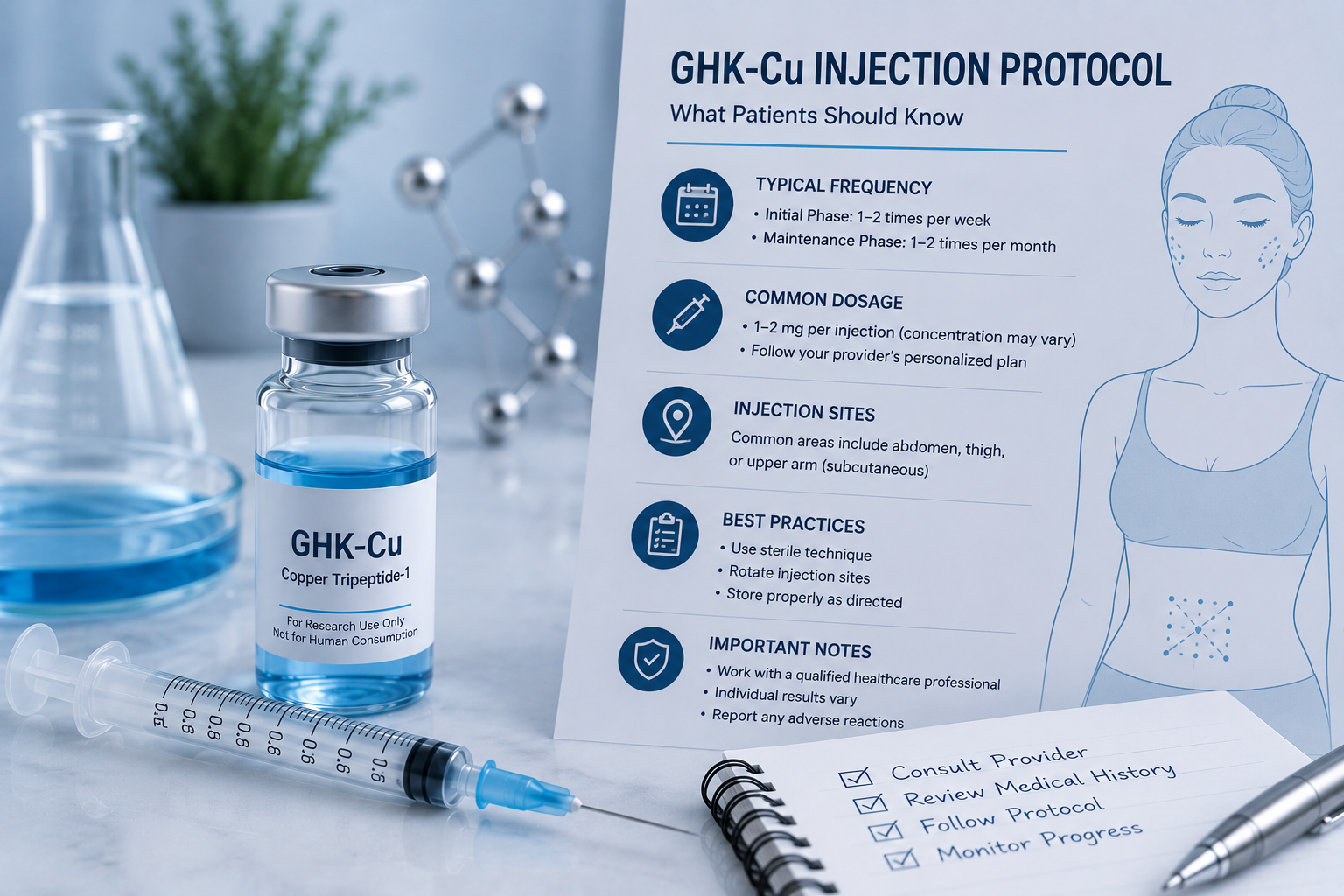

Searches for a GHK-Cu injection protocol often come from patients looking for skin, hair, or anti-aging guidance, but a responsible answer looks very different from a step-by-step plan. Clinics and online sources discuss skin aging, hair, scars, and cosmetic rejuvenation constantly, and it’s understandable that someone would want a clear answer.
That protocol isn’t provided here, and for good reason. Injectable cosmetic peptide procedures depend on patient history, product status, sterile formulation, provider qualifications, jurisdiction, and adverse-event planning, none of which a static page can account for safely.
GHK-Cu injectable claims deserve the same caution regardless of how they’re framed, since copper peptide injections as a category bypass the skin barrier and carry a different risk profile than anything topical.
Everything below is educational, not medical advice: it doesn’t provide dosing or injection instructions, and it isn’t a substitute for a licensed clinician. It focuses on what the evidence shows, what questions to ask a doctor, and what red flags suggest a protocol or provider isn’t safe.
Is There a Standard GHK-Cu Injection Protocol?
There’s no standard GHK-Cu injection protocol to follow, because injectable cosmetic peptide procedures depend on patient history, product status, sterile formulation, provider qualifications, jurisdiction, intended use, and adverse-event planning, variables that genuinely differ from person to person and clinic to clinic.
Online schedules, cycle lengths, dose ranges, or facial injection instructions describe an unsafe GHK-Cu injection protocol almost by definition, since they bypass medical screening and product-quality verification entirely.
GHK-Cu protocol safety depends on medical review, sterile materials, route-specific evidence, qualified administration, and individualized risk assessment, five things a generic schedule can never account for.
Why Protocols Should Not Be Copied From the Internet
An internet protocol can’t account for a specific patient’s medical history. It may rely on unverified products with no real documentation behind them. It may ignore sterility or compounding issues entirely. It’s often built on marketing rather than clinical evidence, however clinical the language sounds. Facial, scalp, and scar-related procedures carry meaningfully different risk profiles from each other, and dose and frequency should never be generalized across different people, products, or goals.
What Matters More Than a Protocol
What genuinely matters here is the evidence itself, the realistic risks, provider qualifications worth checking, specific questions to ask, legal and compounding context, product-quality standards, adverse-reaction warning signs, and safer categories worth discussing with a clinician. That’s a longer list than a dosing chart, and it’s also the version of this topic worth reading in full.
Is There Clinical Evidence Supporting Injectable GHK-Cu?
GHK-Cu has genuine peer-reviewed research support in collagen synthesis, dermal fibroblast activity, extracellular matrix biology, wound models, and gene-expression studies. A peer-reviewed review summarizes much of this research across collagen, elastin, glycosaminoglycan synthesis, wound-model findings, and gene-expression data, and Certified Peptide Solutions’ broader GHK-Cu research overview covers the compound background in more depth. Injectable GHK-Cu evidence for cosmetic protocols specifically is a narrower claim, though, and needs its own route-specific support rather than borrowing conclusions from that broader research base. GHK-Cu clinical evidence is strongest when a claim is tied to a specific route, formulation, endpoint, and study design, not when it’s generalized from one context to a completely different one.
What the Research Supports More Strongly
| Research Area | What Literature Supports | Evidence Caveat |
| Collagen synthesis | Fibroblast and extracellular matrix research | Does not prove injection-based cosmetic outcomes |
| Gene expression | Broad gene-expression effects reported in reviews | Gene changes do not equal clinical results |
| Wound models | Tissue-repair markers in experimental models | Not a wound-care protocol |
| Skin biology | Dermal fibroblast and matrix remodeling research | Route and formulation matter |
| Cosmetic-adjacent research | Some skin-aging discussions exist | Must separate topical/formulation evidence from injection claims |
GHK-Cu skin aging research should stay framed around dermal biology, collagen, extracellular matrix, and gene-expression studies rather than guaranteed rejuvenation.
What Is Still Unclear
Several questions remain genuinely open in this literature: standardized injectable protocols, route-specific safety data, human cosmetic endpoint evidence, long-term adverse-event data, optimal patient selection, interaction data, compounded-product consistency across providers, and sterile formulation standards that hold up across different clinics. None of these gaps are minor footnotes; they’re the substance of what “more research is needed” truly means in this specific case.
Certified Peptide Solutions’ research-purposes-only notice explains the research-use-only framing behind laboratory-grade peptides, a useful anchor for understanding why findings from cell and animal studies stay separate from personal treatment claims.
Who Is Qualified to Administer GHK-Cu Injections?
Who can administer GHK-Cu injections depends on country, state, scope-of-practice rules, product category, and procedure type, so there’s no single universal answer. In general, any injection-based cosmetic or clinical procedure should be handled by a licensed and appropriately trained healthcare professional operating within their legal scope of practice, with medical oversight, informed consent, sterile technique, and adverse-event planning.
A GHK-Cu provider should be qualified to explain evidence limits, sterile technique, documentation, adverse-event planning, and whether the procedure is legally appropriate in that specific location. Any GHK-Cu peptide injection should raise questions about sterility, product identity, compounding, provider credentials, and whether the claimed use is evidence-supported, regardless of how confident the provider sounds.
Provider Qualification Checklist
| Qualification Question | What Patients Should Ask | Red Flag |
| License | Who is the licensed provider? | No named clinician |
| Scope of practice | Are they legally allowed to perform cosmetic injections in this location? | “Technician only” with unclear oversight |
| Training | What training do they have for injections and complications? | Vague experience claims |
| Medical oversight | Is a physician, NP, PA, or other licensed clinician involved? | Sales-only consultation |
| Screening | Is medical history reviewed? | No health questions |
| Product source | What product is used and where does it come from? | Unclear sourcing |
| Sterility | Is the product sterile and appropriate for injection? | Purity claim only |
| Emergency plan | What happens if there is an adverse reaction? | No adverse-event protocol discussed |
| Informed consent | Are risks and alternatives explained? | Benefits-only discussion |
Can GHK-Cu Injections Help With Skin Aging?
GHK-Cu is relevant to skin-aging research because it’s been studied in dermal fibroblasts, collagen synthesis, extracellular matrix remodeling, and gene-expression contexts, a genuinely substantial body of work. None of that proves that GHK-Cu injections reliably improve skin aging. Injectable claims require route-specific evidence, standardized outcomes, and safety data that this broader research doesn’t provide on its own.
What Can Be Said Safely
- “GHK-Cu is studied in skin biology.”
- “GHK-Cu research includes collagen and extracellular matrix markers.”
- “Some literature connects GHK-Cu to aging-related dermal biology.”
- “Injection-specific claims require stronger evidence.”
What Should Not Be Said
- “GHK-Cu injections reverse aging.”
- “GHK-Cu injections reduce wrinkles.”
- “GHK-Cu injections rejuvenate skin.”
- “GHK-Cu injections restore collagen.”
- “GHK-Cu injections are proven anti-aging treatments.”
Can GHK-Cu Support Wound Healing or Tissue Repair?
GHK-Cu wound healing research includes wound-model and tissue-repair studies covering collagen, fibroblast, epithelialization, and extracellular matrix markers. GHK-Cu tissue repair research is relevant to collagen and extracellular matrix biology specifically, but it doesn’t establish a standard injection protocol. These findings support research interest rather than a claim that GHK-Cu injections heal wounds or repair tissue in real patients.
Wound-Model Research vs Patient Treatment
Wound-model research can demonstrate mechanisms worth understanding at a cellular or tissue level. Patient wound care is a different undertaking entirely, requiring clinical diagnosis, infection control, medical treatment, and wound-specific management that a peptide alone can’t replace. Cosmetic injections shouldn’t be promoted as wound-healing treatment on the strength of laboratory findings, and scar-remodeling claims specifically need considerably stronger clinical evidence than currently exists.
Why Scar Protocol Claims Are High-Risk
Scars vary enormously by age, depth, type, location, and tissue condition, which means a generic protocol can’t account for any individual scar’s real characteristics. Injection around scar tissue specifically can create complications that differ from injection into healthy tissue. Online scar-remodeling protocols should be avoided entirely, and anyone considering treatment for a scar should seek qualified medical evaluation rather than a downloaded plan.
Are GHK-Cu Injections Legal in My Country or State?
Legality depends on jurisdiction, product category, compounding rules, prescription status, provider scope of practice, and whether the product is marketed as cosmetic, clinical, compounded, or research-use, and that answer genuinely varies rather than resolving to a single yes or no. Patients should ask a licensed provider and, where relevant, a licensed pharmacy how the specific product is regulated in their location.
What Determines Legal Status
| Factor | Why It Matters |
| Country / state law | Rules vary by jurisdiction |
| Product category | Cosmetic, drug, compounded drug, research material, or device-combination context |
| Provider scope | Not every provider can legally perform injections |
| Pharmacy role | Compounded products must follow applicable compounding rules |
| Product claims | Therapeutic claims can change regulatory status |
| Route of administration | Injectable products face stricter safety concerns |
| Research-use labeling | Research-use materials are not patient treatment products |
| Device involvement | Microneedling or injection devices may have separate rules |
Compounded GHK-Cu Products
Compounded GHK-Cu should be discussed carefully, since compounded products are not the same as FDA-approved drugs and are subject to jurisdiction-specific rules that can and do change. FDA’s compounding Q&A explains the regulatory framework for compounded drugs, including important limitations around what can and can’t be compounded.
Regulated compounded peptides should be evaluated through pharmacy licensing, compounding rules, sterility, documentation, and provider oversight, and patients should ask specifically whether the product is compounded, who compounds it, whether the pharmacy is licensed, and what documentation is available. Whether compounded GHK-Cu is permitted in a given case depends entirely on the specifics: the substance, the pharmacy, the jurisdiction, and the intended use.
Cosmetic, Research, and Clinical Use: What Is the Difference?
Cosmetic vs clinical use matters because each category carries different evidence, regulatory, and provider-responsibility expectations, even when the same compound is involved.
Use Categories
| Category | What It Means | Patient-Safety Implication |
| Cosmetic use | Intended to affect appearance | Still requires provider qualification, sterile procedure context, and realistic claims |
| Clinical use | Used under medical supervision for a health-related purpose | Requires stronger evidence, diagnosis, consent, and regulatory context |
| Research use | Laboratory use only | Not intended for human cosmetic or medical treatment |
| Compounded product | Prepared by a pharmacy under applicable rules | Not automatically FDA-approved; documentation and legality matter |
| Approved drug | Reviewed by regulators for specific indications | Approved use, labeling, safety, and manufacturing standards are defined |
Research-use GHK-Cu should never be marketed or used as a personal cosmetic injection. Research-use materials and clinical or cosmetic injectable products are not interchangeable, regardless of how a seller frames the distinction.
What Should Patients Ask a Doctor Before Considering GHK-Cu?
These four categories of questions cover most of what matters before considering any GHK-Cu procedure.
Evidence Questions
- What evidence supports injectable GHK-Cu for this intended use?
- Are claims based on topical studies, cell studies, animal models, or human injection data?
- What outcomes are realistic?
- What evidence is still missing?
- Are there safer or better-studied alternatives?
Safety Questions
- What are the known and unknown risks?
- What side effects should be watched for?
- What symptoms require urgent care?
- Who should avoid the procedure?
- How will adverse events be handled?
- How is infection risk reduced?
Product and Quality Questions
- What exact product is used?
- Is it sterile?
- Is it compounded?
- Is the pharmacy licensed?
- Is there a batch-specific COA?
- Does the COA include identity and purity testing?
- Is endotoxin or sterility testing available where relevant?
- Is the product labeled for research use only?
Legal and Provider Questions
- Are you licensed to administer this in my state or country?
- Is this within your scope of practice?
- What informed consent is provided?
- How is this procedure documented?
- What follow-up is included?
What Makes a GHK-Cu Injection Protocol Unsafe?
A handful of signals reliably indicate that a protocol, provider, or product isn’t safe to trust.
Unsafe Protocol Signals
| Unsafe Protocol Signal | Why It Is Unsafe |
| Public dose or schedule copied online | Ignores patient-specific medical review |
| Around-eye or around-mouth instructions | Facial anatomy creates higher procedural risk |
| Hair or scar protocols without diagnosis | Treats complex conditions as generic cosmetic issues |
| Research-use product used for injection | Research materials are not patient products |
| No sterile formulation confirmation | Injection bypasses skin barrier |
| Purity claim without sterility data | HPLC purity does not prove injectable safety |
| No provider license | No clear clinical accountability |
| No adverse-event plan | Patients may not know when to seek help |
| No medication/supplement review | Interaction or bleeding-risk concerns may be missed |
| No informed consent | Benefits may be emphasized over risks |
| Before/after marketing as proof | Testimonials are not clinical evidence |
| Claims of guaranteed rejuvenation | Overstates evidence |
What Quality or Sterility Standards Matter for Injectable Peptides?
Injectable peptides require a higher standard than topical or research-use materials.
Injectable peptide sterility is a separate safety question from peptide purity and requires route-appropriate documentation that a basic purity report often doesn’t include.
Peptide sterility standards matter because injectable materials must meet a meaningfully higher safety threshold than topical or research-use materials do.
Broader GHK-Cu injection risks, including infection, contamination, and product-identity problems, connect directly back to these same documentation gaps, and GHK-Cu side effects for cosmetic injectable use remain poorly standardized in public clinical literature.
FDA guidance on clinical pharmacology for peptide drug products outlines the kind of structured safety, pharmacokinetic, and immunogenicity evaluation that formal peptide drug development requires, evaluation research-use or compounded GHK-Cu material typically has not gone through.
Injectable Peptide Quality Checklist
| Quality Question | Why It Matters |
| Is the product sterile? | Injectable materials bypass the skin barrier |
| Is endotoxin testing available where relevant? | Endotoxins can create serious inflammatory reactions |
| Is identity confirmed? | Confirms the material matches the label |
| Is purity tested? | Helps evaluate impurities |
| Is the COA batch-specific? | Links documentation to the exact lot |
| Is the pharmacy or manufacturer identified? | Supports traceability |
| Is storage documented? | Peptides can degrade if handled poorly |
| Is the product intended for injection? | Research-use or topical products are not interchangeable |
| Is the provider trained in sterile procedure? | Technique affects risk |
| Is adverse-event follow-up available? | Safety does not end after the procedure |
Purity vs Sterility
Purity testing evaluates chemical composition and impurities. Sterility testing evaluates microbial contamination risk. These are genuinely different questions, and a product can look chemically pure on a COA while still being entirely inappropriate for injection if sterility and route suitability were never established in the first place.
COA vs Clinical Safety
A GHK-Cu COA can support quality evaluation, but it doesn’t prove clinical safety, legal status, or appropriateness for injection on its own. It should be batch-specific and should match the product name, lot number, test date, method, and purity result, but even a strong COA answers a narrower question than “is this safe for me” ever asks. Peptide purity testing can support quality evaluation, but purity testing alone does not prove sterility, clinical safety, or injection suitability, worth repeating since cosmetic peptide injections are so often evaluated by before-and-after marketing rather than sterility, training, and documentation, the things that matter most.
Certified Peptide Solutions’ COA library shows what batch-specific documentation looks like in practice, a useful comparison point when evaluating whether a provider’s paperwork meets that same standard.
Can GHK-Cu Interact With Medications or Supplements?
Public clinical literature on GHK-Cu injection interactions is limited, so patients shouldn’t assume there are no interactions simply because none have been well documented yet. A clinician should review medications, supplements, skin procedures, bleeding risk, immune status, allergies, copper metabolism concerns, pregnancy status, and any dermatologic or wound-healing conditions before any procedure, a conversation worth having in full rather than assuming any single factor is the only one that matters.
What to Tell a Provider
- Prescription medications
- Over-the-counter drugs
- Supplements
- Anticoagulants or antiplatelet agents
- Isotretinoin or other dermatologic medications where relevant
- Immune-suppressing medications
- History of allergies or reactions
- Copper metabolism disorders or concerns
- Active infections
- Recent skin procedures
- Pregnancy or breastfeeding status
- History of keloids or abnormal scarring
Who Should Avoid GHK-Cu Injections?
Whether GHK-Cu injections are appropriate for a given person is a genuinely individualized medical judgment, not a generic yes-or-no answer. The situations below call for medical review before considering a cosmetic injection at all.
Ask a Clinician First If You Have
- An active skin infection
- Open wounds near the treatment area
- A history of severe allergic reactions
- Immune suppression
- Bleeding disorders
- Use of blood thinners or medications affecting bleeding risk
- Pregnancy or are breastfeeding
- Copper metabolism disorders or related concerns
- A history of keloids or abnormal scarring
- Recent facial procedures
- Uncontrolled chronic medical conditions
- Cancer history or active malignancy concerns
- An unclear product source
- A prior adverse reaction to peptide or injectable treatments
These aren’t absolute rules that apply the same way to every patient; they’re reasons to seek individualized medical review before moving forward with anything.
What Symptoms May Indicate an Adverse Reaction?
Recognizing warning signs matters. A possible GHK-Cu adverse reaction should be evaluated by a qualified medical professional, especially if symptoms are severe, spreading, systemic, or persistent.
Adverse-Reaction Symptoms
| Symptom Category | Examples | What to Do |
| Local irritation | Redness, swelling, tenderness, bruising | Mild local symptoms can occur after skin procedures, but persistence or worsening should be reviewed |
| Infection concern | Spreading redness, warmth, pus, worsening pain | Seek medical care if infection signs appear |
| Allergic reaction | Hives, itching, swelling away from the injection site | Contact a medical professional promptly |
| Severe reaction | Trouble breathing, facial/throat swelling, dizziness, fainting | Seek emergency medical care |
| Tissue concern | Severe pain, skin color changes, ulceration | Requires urgent professional evaluation |
| Eye-area concern | Vision changes, severe swelling, eye pain | Seek urgent medical care |
| Systemic symptoms | Fever, chills, malaise | Needs medical evaluation |
Safer Alternatives to GHK-Cu Injections
Safer alternatives to GHK-Cu injections depend heavily on the patient’s real goal and medical context, and the categories below are meant to prompt a conversation with a licensed clinician, not to function as a treatment recommendation on their own. GHK-Cu hair research in particular should be discussed cautiously, since hair-related claims require route-specific human evidence that currently doesn’t exist for injectable use.
Lower-Risk or Better-Studied Options to Discuss With a Professional
| Goal | Options to Ask About | Why This May Be Safer |
| General skin aging | Evidence-based skincare, sun protection, dermatologist-guided topicals | Non-injectable and better characterized |
| Collagen support | Topical retinoids, vitamin C, procedure-based options under dermatology care | More established cosmetic pathways |
| Texture or scars | Dermatologist-guided resurfacing, lasers, microneedling with authorized devices | Supervised procedures with clearer device frameworks |
| Hair concerns | Dermatology evaluation, approved hair-loss treatments where appropriate | Hair loss has many causes and needs diagnosis |
| Wound concerns | Medical wound care | Wounds require diagnosis and infection management |
| Peptide interest | Research-focused education and provider discussion | Avoids self-protocols and gray-market products |
FDA’s consumer guidance on microneedling is a useful reference for the texture/scar row specifically, explaining that skin-barrier procedures carry both benefits and risks that deserve a safety-first discussion.
For readers researching copper peptide procedures, Certified Peptide Solutions’ lab testing page explains how GHK-Cu and related research peptides are verified before they reach a research bench.
How Does GHK-Cu Compare With Other Peptides?
This comparison stays high-level and mechanism-based, not a ranking or a suggestion to combine anything for injection.
GHK-Cu vs Other Research Peptides
| Peptide | Research Category | Difference From GHK-Cu |
| GHK-Cu | Copper peptide, collagen, extracellular matrix, dermal biology, gene expression | Stronger association with skin biology and ECM research |
| AHK-Cu | Copper peptide comparison, skin/hair research discussions | Related copper peptide category but different sequence and evidence profile |
| KPV | Alpha-MSH fragment, inflammatory signaling, gut mucosal models | More immune/inflammatory-pathway focused |
| BPC-157 | Tissue-stress, gastrointestinal, angiogenesis, repair-pathway models | Often discussed in tissue-repair contexts but not the same mechanism |
| TB-500 | Thymosin beta-4 fragment, actin/cell migration/tissue-remodeling research | More migration/remodeling pathway focused |
| SS-31 | Mitochondrial and oxidative stress research | Mitochondrial pathway focus |
| NAD-related research | Cellular energy and redox biology | Not a peptide; relevant to cellular metabolism |
Each compound sits in a different research category with a different evidence profile.
A detailed comparison of GHK-Cu and AHK-Cu covers the closest comparison in more depth for readers specifically weighing those two copper peptides. KPV’s alpha-MSH fragment research sits in a genuinely separate inflammatory-signaling category, and the BPC-157 research primer covers a tissue-repair mechanism that doesn’t overlap with GHK-Cu’s copper-binding biology. NAD-related cellular energy research is relevant to metabolism specifically, not extracellular matrix or skin biology, reinforcing the same point: none of these categories should be combined into an injection stack based on this table alone.
How Can Users Identify Misleading GHK-Cu Claims?
Misleading GHK-Cu claims often turn collagen, wound-model, or gene-expression research into guaranteed cosmetic outcomes, stretching a laboratory finding into a marketing promise the study never made.
Red Flags to Watch For
- Guaranteed skin rejuvenation
- “Clinical-grade anti-aging protocol” language with no clinical evidence behind it
- Injection schedules published for everyone regardless of individual factors
- Around-eye or around-mouth protocol advice
- Hair-regrowth promises
- Scar-remodeling guarantees
- “No side effects” claims
- “Research use only” products marketed as cosmetic injections
- No provider credentials listed anywhere
- No sterility documentation
- Purity claims used as safety proof
- Before/after photos presented as evidence
- No discussion of complications
- Pressure-based sales tactics
Safe vs Unsafe Claim Framing
Safe framing sounds like “GHK-Cu is studied in collagen and skin biology research” or “injectable use requires route-specific evidence and qualified medical review.” Unsafe framing sounds like “GHK-Cu injections reverse aging” or “follow this protocol for best results.” The difference isn’t subtle once you’re looking for it: one describes research, and the other promises an outcome.
What Should a Medically Reviewed GHK-Cu Article Disclose?
A medically reviewed GHK-Cu article should disclose considerably more than most cosmetic-procedure content does. At minimum, that includes reviewer credentials, publication and update dates, evidence sources, and whether the underlying evidence is topical, injectable, in vitro, animal, or human. It should also disclose regulatory uncertainty, compounded-product context, the distinction between research-use and clinical-use materials, and the fact that it isn’t providing public protocol guidance.
Beyond that, disclosure should extend to risks and adverse symptoms, contraindication questions, why medication and supplement review matters, provider qualification requirements, sterility and documentation standards, and when to seek urgent medical care. If the content is tied to a seller or clinic, that connection should be disclosed too, since it changes how a reader should weigh the claims being made.
GHK-Cu Injection Protocol FAQ
Is there a standard GHK-Cu injection protocol?
A public article should not provide a standard GHK-Cu injection protocol. Injectable cosmetic procedures require qualified medical review, sterile products, patient screening, legal compliance, and adverse-event planning.
Is there clinical evidence supporting injectable GHK-Cu?
GHK-Cu has peer-reviewed research support in collagen, extracellular matrix, dermal fibroblast, wound-model, and gene-expression studies. Injection-specific cosmetic evidence is more limited and should be evaluated separately from topical or laboratory research.
Who is qualified to administer GHK-Cu injections?
Qualification depends on jurisdiction, scope of practice, product category, and procedure type. Patients should look for a licensed and appropriately trained healthcare professional who can provide informed consent, sterile technique, and adverse-event planning.
Can GHK-Cu injections help with skin aging?
GHK-Cu is relevant to skin-aging research through collagen, fibroblast, extracellular matrix, and gene-expression biology. That does not prove GHK-Cu injections reliably improve skin aging or reduce wrinkles.
Can GHK-Cu support wound healing or tissue repair?
GHK-Cu has been studied in wound-model and tissue-repair research. These findings should not be translated into claims that GHK-Cu injections heal wounds or repair tissue in patients.
Are GHK-Cu injections legal?
Legality depends on country, state, product category, compounding rules, prescription status, provider scope of practice, and intended use. Patients should ask a licensed provider and pharmacy how the product is regulated in their location.
What makes a GHK-Cu injection protocol unsafe?
Unsafe protocol signs include online dosing, generic schedules, facial-site instructions, research-use products marketed as injections, no sterility documentation, no provider license, no adverse-event plan, and guaranteed cosmetic claims.
What symptoms may indicate an adverse reaction?
Severe pain, spreading redness, warmth, pus, fever, hives, breathing difficulty, facial or throat swelling, dizziness, skin color changes, ulceration, or vision changes require prompt medical attention.
GHK-Cu Injection Protocol Searches Deserve a Safer Answer
The safest way to approach a GHK-Cu injection protocol search is to avoid online schedules or dosing instructions and focus on qualified medical review, evidence limits, sterility, documentation, and adverse-reaction awareness instead. Peptide injection safety depends on patient history, product sterility, provider training, and jurisdiction-specific rules, all of which matter more than a generic schedule ever could.
A genuinely medically reviewed GHK-Cu article points readers toward a licensed clinician rather than a protocol, and toward evidence-aware questions rather than confident-sounding promises. That redirect is the most honest answer a public page can give.
Certified Peptide Solutions’ about page outlines the company’s research-focused, documentation-first approach to peptide education, the same standard patients should expect from any GHK-Cu provider or product.